When I moved to Crete, Illinois, I didn’t expect that a five-day curriculum unit would change how I saw my community or myself. I came with an educator’s mindset and a heart for justice, but what unfolded over the next several months was far more than a lesson plan. It was a journey of reconnection, reckoning, and restoration. And it all began with a question: What would it mean for students to see themselves not just as learners of history, but as part of it?
That question anchored our work as a team of educators supported by the Will County Regional Office of Education’s Social Emotional Learning (SEL) Hub Grant. Together with educators from Crete-Monee School District 201-U, we developed a week-long curriculum unit that explored the Underground Railroad through the lens of Caroline Quarlls, a young freedom seeker whose story began in St. Louis and passed through Crete on her way to Canada. Our team, including William Fitzgerald, Kimberly Moore, Mark O’Connor, Sarah Valerio, and myself, built this curriculum with a deep commitment to place-based education and social-emotional learning.
To ensure authenticity and accuracy, we consulted local history resources and received support and insight from the Crete Area Historical Society and Museum. These local partnerships were instrumental in helping us understand the role of our community in the broader narrative of the Underground Railroad.
And yet, one of the most formative parts of this journey didn’t come from a textbook or document archive. It came from listening deeply and humbly. After completing the initial curriculum, I realized that while our first edition of the unit was grounded in good intentions, it had not adequately included the lived expertise of Kimberly Simmons, a direct descendant of Caroline Quarlls. That realization stopped me in my tracks.
Rather than move forward with that version, I reached out and arranged to meet Ms. Simmons virtually first, and then later in person. I also had the opportunity to engage with Dr. Larry McClellan, one of the foremost historians on the Underground Railroad in Illinois. Both Dr. McClellan and Ms. Simmons are the co-authors of To the River, a vital text that became central to our curriculum unit.
It was thanks to an introduction through the National Park Service, that I was introduced to Ms. Simmons, who welcomed me into a conversation that became a turning point. I attended a symposium she spearheaded at the University of Windsor in Canada, where she shared the deeply significant historical connections between the Detroit River, Canadian freedom, and the networks of resistance that carried freedom seekers across borders. Her perspective, and the historical truths she carries with both authority and grace, reshaped how I understood the narrative we were teaching.
Ms. Simmons personally reviewed and approved the revised edition of our unit. That was more than a professional milestone. It was a moment of humility. A reminder that good intentions don’t replace responsible storytelling, and that proximity to a story does not equal ownership of it. It was a lesson in what it means to approach this work with the respect it deserves.
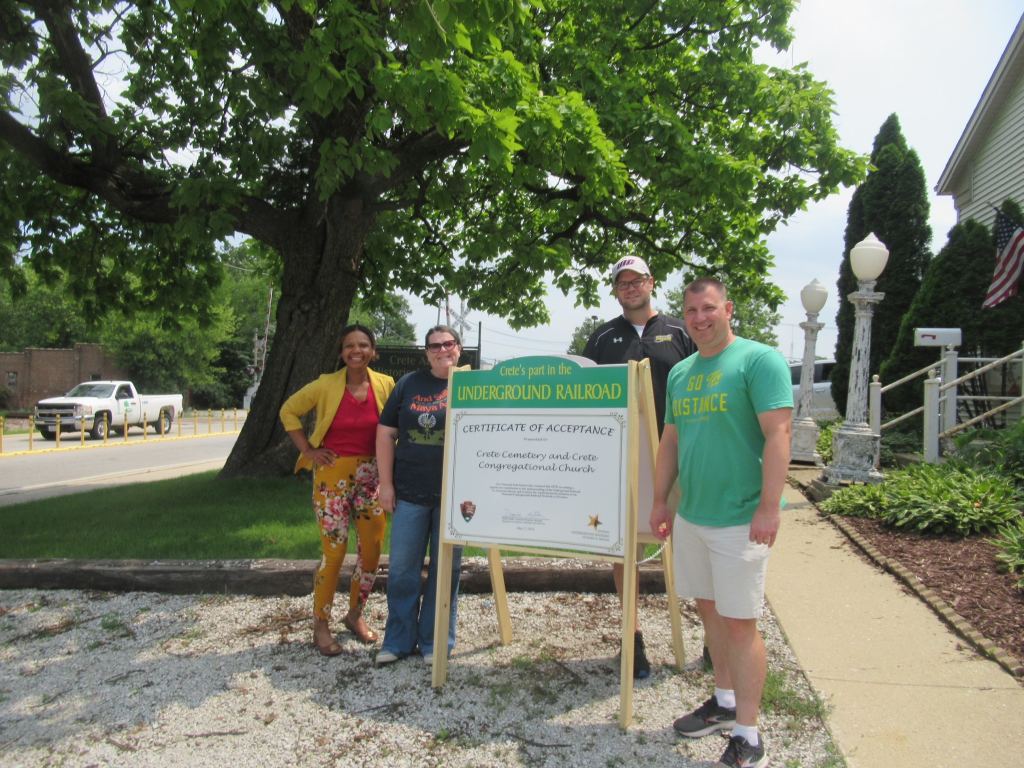
What emerged from these relationships was not only a powerful social studies unit but a dynamic way for students to connect with the land they walk every day. Through maps, primary sources, and values-based reflection, students didn’t just learn about the Underground Railroad, they traced its path through their neighborhoods. They explored how places like the Crete Cemetery and Crete Congregational Church connect directly to stories of resistance, courage, and legacy. Some even brought their families to visit these sites, sparking long-overdue intergenerational conversations.
This curriculum didn’t stay in the classroom. It became the catalyst for the Village of Crete’s first organized Juneteenth celebration held in 2023, a small but deeply meaningful event that was sponsored by family and the Crete Area Historical Society and Museum. That small gathering grew into a larger, more formal event (Juneteenth at the U), supported by Crete-Monee School District 201-U, local businesses, Monee Township, Prairie State College, and Governors State University. The celebration, like the curriculum, was rooted in truth-telling, joy, and reclamation.
Eventually, this journey led me to co-author We Celebrate Juneteenth Unidos, a bilingual children’s book inspired by Juneteenth at the U. Through the voice of a grandmother and her granddaughter, the book invites all families to see Juneteenth not as a historical footnote, but as a thread connecting past, present, and future.
Throughout this process, I’ve learned that you don’t need to be a credentialed historian to begin this work. You don’t need to be an “expert” to care deeply or lead thoughtfully. What you do need is a willingness to listen, to be corrected, to seek out those who know more, and to let your curiosity guide you with humility and care.
We are all part of living history. And the more we approach that truth with a curious and open spirit, the more meaningful our learning and our teaching becomes.
So to every educator, parent, neighbor, or community leader reading this: let this be your invitation. Be bold enough to ask what history lives in your backyard. Be brave enough to learn what you were never taught. And be willing to say, *I didn’t know but I want to.*
Because honoring the past doesn’t just shape the future. It shapes us.